Winter Farmhouse Decor That’ll Make You Actually Want to Stay Inside
Contents
- Winter Farmhouse Decor That’ll Make You Actually Want to Stay Inside
- Why Your House Feels Empty After Christmas (And What to Do About It)
- The Real Cost of Creating This Look (Spoiler: It’s Not What You Think)
- What Makes Winter Farmhouse Different From Regular Farmhouse
- Your Winter Farmhouse Color Palette (Choose Your Fighter)
- The Non-Negotiable Pieces You Actually Need
- What I Forage (And What I Fake)
- How to Style Your Mantel Without Looking Like a Pinterest Fail
Winter farmhouse decor transforms your home into a cozy sanctuary when the holidays end and that post-Christmas letdown hits hard.
You know that weird feeling in early January? The tree’s gone, the sparkle disappeared overnight, and your house suddenly looks naked and sad.
I’ve been there, staring at blank mantels and wondering why my living room suddenly felt like a waiting room.
Here’s what nobody tells you: winter decor doesn’t end when you pack away the ornaments. It’s actually just getting started.

Why Your House Feels Empty After Christmas (And What to Do About It)
The problem isn’t that you removed decorations. The problem is you removed all the warmth along with them.
Those twinkling lights, soft textures, and layered surfaces weren’t just festive—they made your space feel lived-in and inviting.
Winter farmhouse decor brings back that coziness without the Christmas chaos.
I learned this the hard way three years ago when I stripped my house bare on January 2nd, then spent two months feeling depressed in what resembled a beige cave.
Never again.
The Real Cost of Creating This Look (Spoiler: It’s Not What You Think)
Let me be straight with you.
You can absolutely nail this style on a shoestring budget if you’re willing to get creative.
Budget breakdown:
- Thrift store route: $50-100 (vintage brass, ironstone pieces, glass containers)
- Nature walk approach: Free to $30 (pinecones, branches, plus a few faux fur throw pillows)
- Curated investment: $200-500 (quality neutral throw blankets, proper greenery, beautiful candleholders)
I’ve done it all three ways.
The cheap version looks just as good in photos, honestly. The expensive version feels better to touch and lasts longer.
Pick your priority.
What Makes Winter Farmhouse Different From Regular Farmhouse
This isn’t your basic shiplap-and-mason-jars situation.
Winter farmhouse leans heavily into:
- Woodland vibes (think cabin in the woods, not barn in the field)
- Softer textures (less metal signs, more chunky knits)
- Muted natural tones (cream, warm brown, soft sage, dusty blue)
- Organic shapes over geometric patterns
The whole vibe screams “hibernate here with hot chocolate and a good book.”
Which, let’s be honest, is exactly what January through March demands.
Your Winter Farmhouse Color Palette (Choose Your Fighter)
Option 1: Warm Earth Tones
- Creamy whites
- Warm browns and tans
- Brass and copper accents
- Deep forest greens
This palette feels like a hug. I use this in my living room because north-facing windows make it perpetually chilly.
Option 2: Cool Winter Neutrals
- Icy whites
- Soft grays
- Muted blues and sages
- Silver and pewter metallics
This one’s for south-facing rooms that get tons of light. It keeps things fresh instead of stuffy.
Pro move: Pick ONE palette and commit to it throughout your main living spaces.
Mixing both looks confused and wishy-washy.

The Non-Negotiable Pieces You Actually Need
Forget those shopping lists with forty-seven items.
Here’s what actually matters:
For texture:
- One chunky knit throw blanket in cream or oatmeal
- Two or three pillows with different textures (faux fur, cable knit, linen)
For greenery:
- Fresh eucalyptus, pine, or boxwood (grocery store floral section, people)
- Or quality faux if you’re not into replacing stems every two weeks
For warmth:
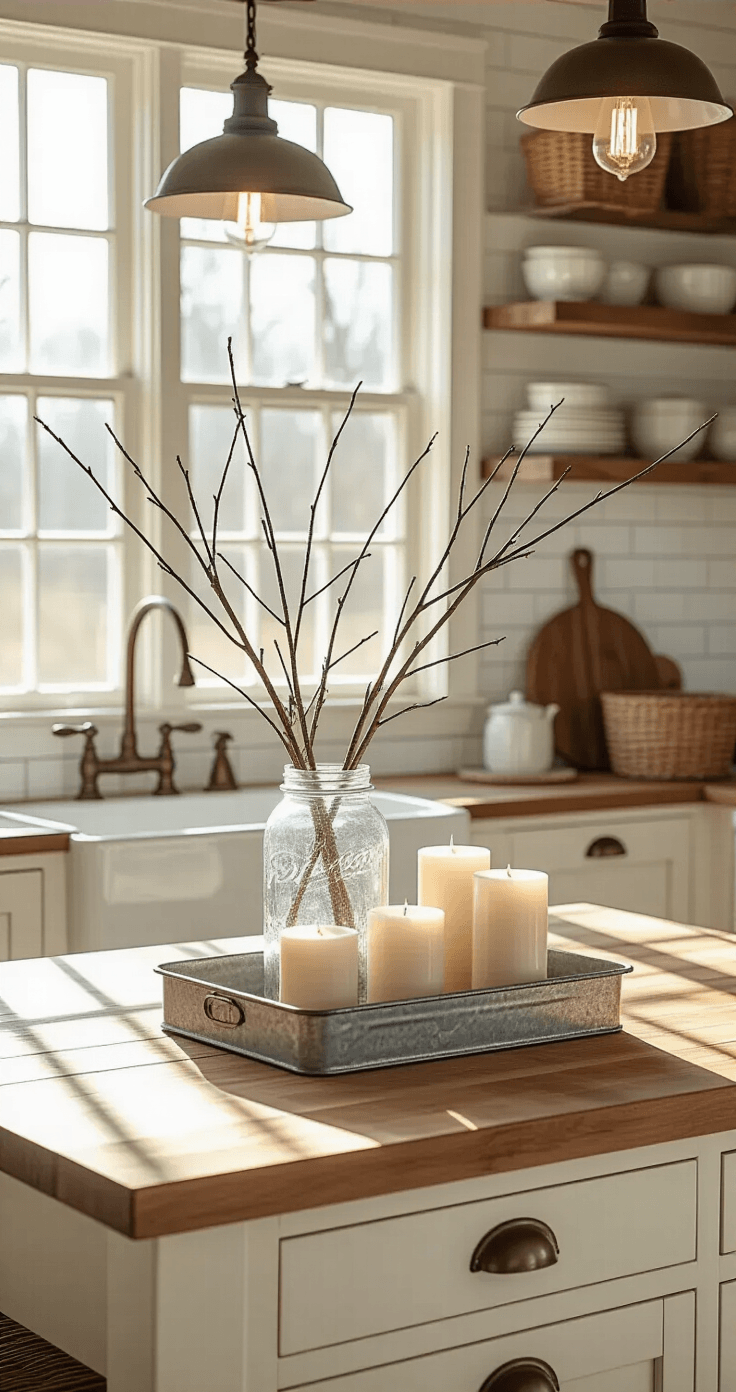
- Candles in mercury glass or simple holders
- I’m obsessed with pillar candles in varying heights—they look expensive but aren’t
For the farmhouse bit:
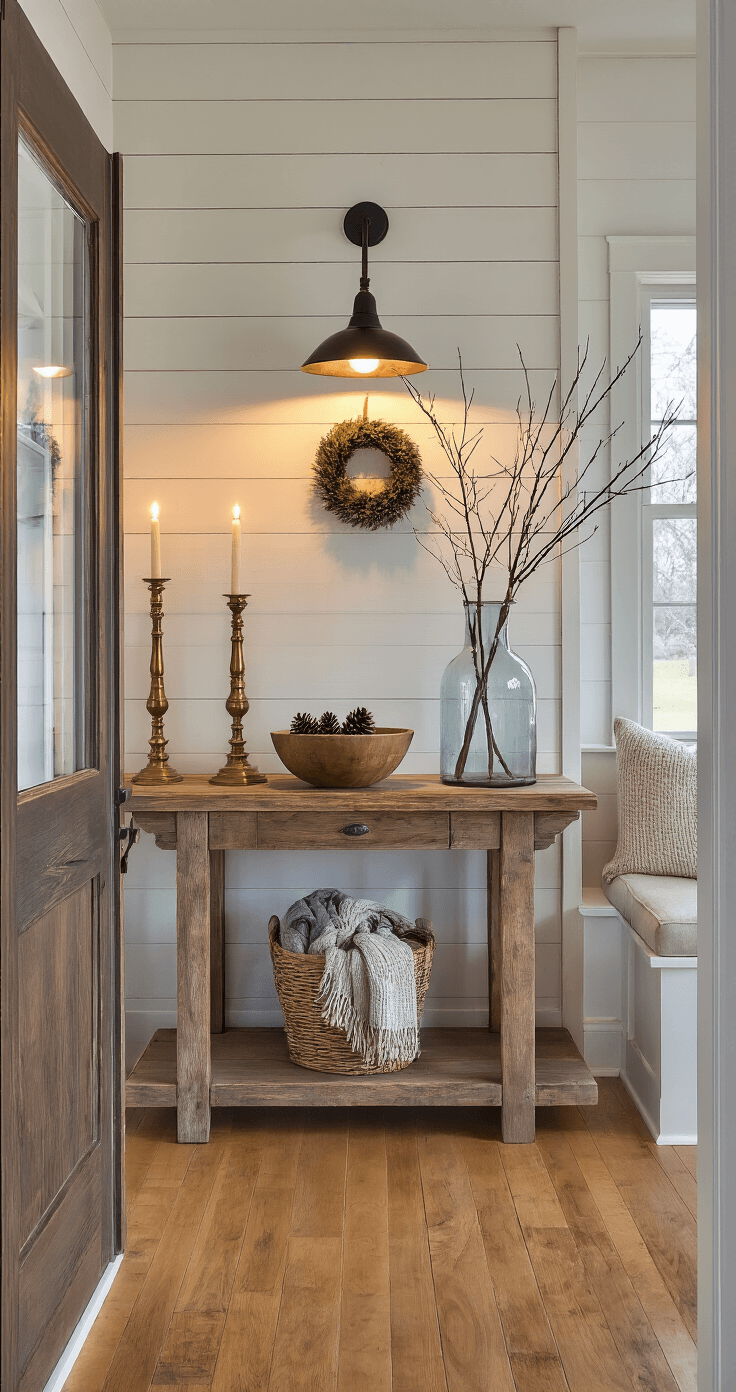
- Vintage brass candlesticks (thrift stores are goldmines)
- Wooden bowls or cutting boards
- One statement piece of ironstone or vintage pottery
That’s it.
Everything else is gravy.
What I Forage (And What I Fake)
Real talk: I’m not trudging through snow looking for the perfect pinecone.
But I do clip branches from my yard.
Worth foraging or clipping:
- Bare branches (spray paint white for drama if you’re feeling fancy)
- Pinecones from your neighborhood
- Evergreen clippings (with permission, obviously)
Worth buying faux:
- Eucalyptus garlands (real ones get crunchy and drop everywhere)
- Most greenery if you have pets who eat plants
- Those gorgeous snow-dusted pinecone picks
I mix real and fake shamelessly. Nobody’s inspecting your greenery up close unless they’re weird.
How to Style Your Mantel Without Looking Like a Pinterest Fail
This is where people panic and either under-do it (three lonely candles) or overdo it (craft store explosion).
My formula that works every single time:
- Start with greenery as your base
This post may contain affiliate links. Please see my disclosure policy for details.